

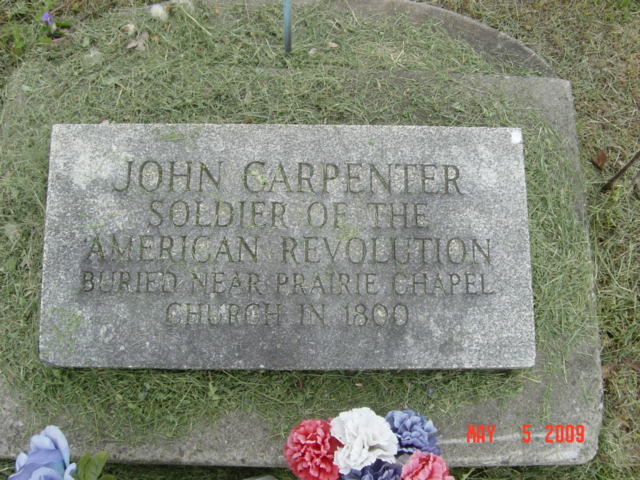
While there are many tales of capture and killings all along the areas of the Ohio Valley, few are remembered or even recorded. However, the ones that do survive arrange a puzzle of clear vision and the brutality that was once replete in our area. One of these tales is about an early settler by the name of John Carpenter.
Before one can appreciate the tale, it must be paramount to the reader to comprehend the precise term, in this specific area, what is known as Indian Summer; it is to be understood because this is the time of year whence this tale takes place.
During the severely cold winter months, Indian activity in the area was considerably inactive; the snow and bitter cold could not permit much retaliation or attacks of Indians on white settlers. This proved to be the exact on the side of White Settlers as well. Forest travel was strictly to those who possessed impressive knowledge of deer trails and trusted companions of a certain area. As a result, most Indians in the area would rely on fishing and consumption of dry meat and vegetables to get through the winter months. Subsequently, at various periods in the height of winter, a favorably warm spell would break the merciless cold; it was rightfully called the “Indians Summer.” Early in the month of March, a warm spell entered the landscape of the frigid cold; this produced activity and an advantage to any Indian seeking food or supplies for himself or his family. It was at this time that the legendary John Carpenter of the Ohio Valley found himself in serious danger. Sometime during the night in early March, while attending to his horses in his barn, a commotion was outside, and Mr. Carpenter found himself in the unwanted confrontation of Wyandots. Here they took Carpenter prisoner, along with his two horses; they made him cross the Ohio River, along with his horses, nearly drowning in the frozen water as it was rising in depth because of the early warm thaws from the higher temperatures. Travelling towards the Muskingum River, he entered a Moravian town where the Indians had established peaceful villages with their neighbors. By this time, John Carpenter was not a man without reputation and his captors knew this. In an unsuccessful attempt, they tried to convince him to join them in their quest to fight the British; he played along as well as any astute white settler would do. As some horses made their way in any fashion they pleased in the village, Carpenter secured his escape by riding one out of the village and back towards home; however, this is only one story of his magnificent legacy.
Before he became a well-known Indian fighter, John Carpenter was a soldier in the French and Indian War serving under the command of Colonel George Washington in the Virginia Regiment. Washington said of him “that as he could not run fast, the British or Indians would eventually get him”; the Indians would get him, not once, but twice, and they could not kill him; he fought along the entire Ohio Valley region before establishing the numerous settlements that bear his name. After his service in this war, Mr. Carpenter found his service in the military again, this time in the American Revolution. He served as a Quartermaster Sergeant (a non-commissioned officer) for three years being discharged in 1781. However, his first duty in the American Revolution was, once again, under the command of now General George Washington, at Valley Forge; from there, he joined with Washington in pursuit of the British across New Jersey withdrawing from Philadelphia; this movement led him into the Battle of Monmouth where Washington fought the British to a famous standstill. During his time in service during the American Revolution, he resided in western Pennsylvania which was claimed by the state of Virginia; it is believed he owned a farm and cabin in Washington County, Pennsylvania. Mr. Carpenter had ties with Fort McIntosh, Fort Pitt in Pittsburgh as well as maybe even Logstown because of his connections to the Indians of the region. It is noted in marriage licenses of the time that Mr. Carpenter was married to an Iroquois women of considerable reputation and character as a result of a skirmish in a camp he was residing in at the time. In later years, his wife saved his life during a savage Indian attack on their farm where he was shot and was almost killed by a band of Wyandots. He lived out his final years in Ohio passing away in 1806. Over the years, there continued to be lavish and exaggerated rumors on this man, but he still continues to garner the admiration and attention of story tellers and historians to this day.
“Let us picture the man we are here to honor. According to tradition, he was a short-legged, stocky man, who they said, could not run very fast, that the Indians would surely capture him. But he was not the kind of man who ran; he was the kind who stayed to fight. He was an Ohio Pioneer, and those two words are enough to distinguish any man. But there were many more: John Carpenter began his fight for liberty and for the establishment of our Republic soon after he came to Virginia from England in 1750. He was a neighbor of George Washington and he served under him, both in the French and Indian War and in the American Revolution. In the later years of the Revolution he was sent west of the Alleghenies to assist the settlers fighting the Indians and the British. This, no doubt, gave him a liking for the Ohio Country. So in 1781, he brought his family and settled at the mouth of Short Creek, which flows into the Ohio River near the present site of Warrenton, in Jefferson County. There he built a cabin and established a fort, the site is still known as Carpenter’s Fort.” 1

© 2025, admin. All rights reserved.