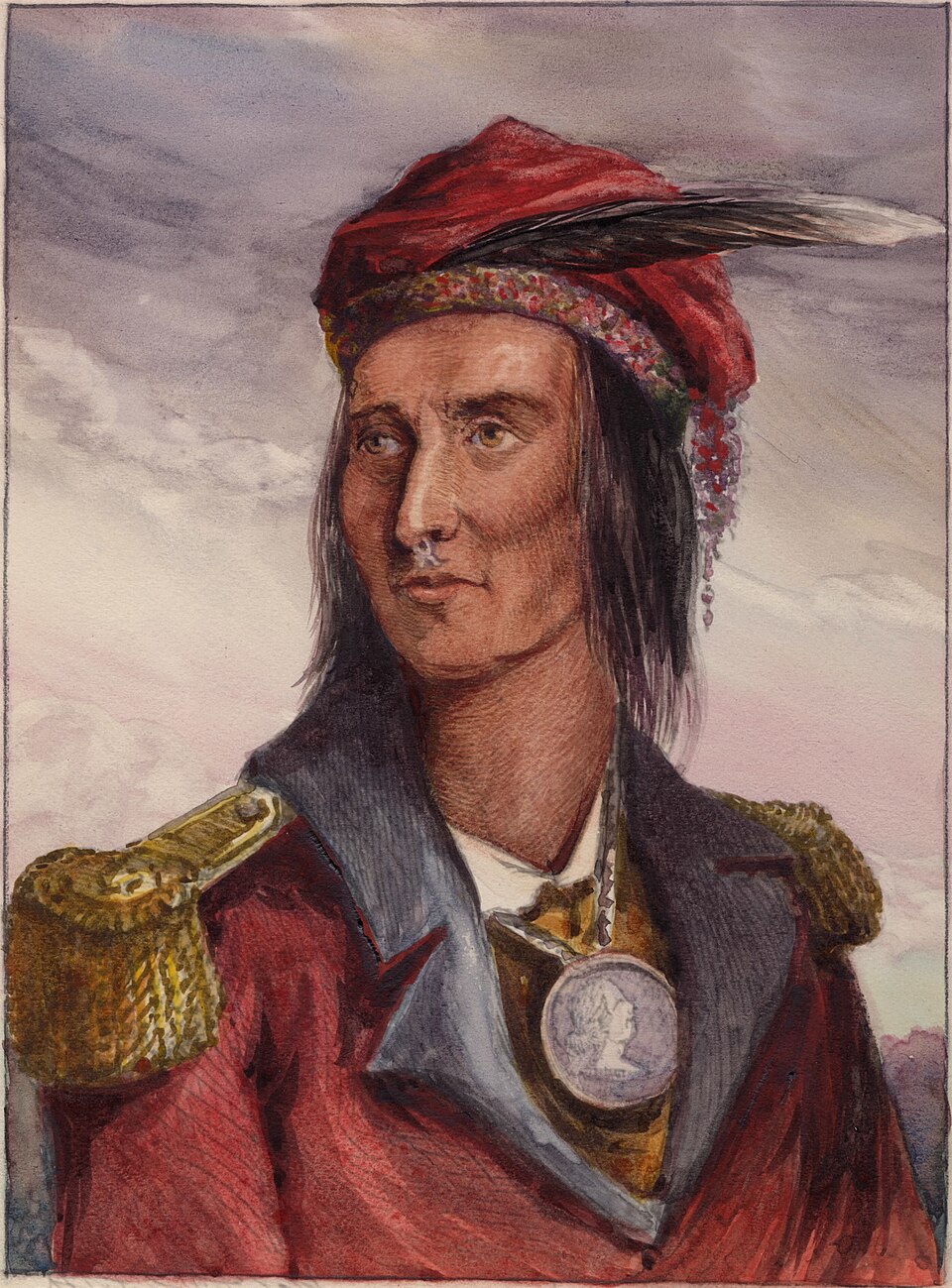
By the early 1800’s, there were several tribes of indigenous peoples who heroically and collectively injected opposition into to the expansion of the United States in native territories, specifically the Ohio Country. One of the most exclusive leaders on this narrative was a Shawnee by the name of Tecumseh. Born in what is now the state of Ohio on March 9th, 1768, his birth year was indentured into fighting for the entire Ohio Country as a reunification act for all Iroquois as well as Algonquian peoples who had resided and hunted on these lands for hundreds of years before the arrival of white settlers and Europeans. As a result of this, it would seem to be Tecumseh’s destiny to be a great chief and defender of his people and lands. His father, also a chief, held prominence in the Shawnee tribes. Sadly, the most grievous action recorded on his father is that he was killed at the Battle of Point Pleasant; when this tragedy expired, Tecumseh was taught the art of fighting and negotiation by his older brother Cheeseekau,who would also die heroically fighting the Americans in 1792.1
For simplicity and focus, it is going to be mentioned that Tecumseh makes his debut in the history calendar by aligning himself with another famous chief of the Ohio Region, Blue Jacket. Like his predecessors, Blue Jacket is zealously committed to removing every single white and American influence from indigenous territory. But, he too, falls short of this vital military objective for his people when he is defeated at the Battle of Fallen Timbers, by a cantankerous and artful General by the name of “Mad”Anthony Wayne, who was not only famous by his commands on the battlefield, but by his rigorous discipline of his troops, which was famously demonstrated at LegionvilleCamp in Baden, Pennsylvania. This camp would be the first of its kind to offer training facilities for new army recruits. But, before all of this, an ordinary infant was born who would grow up and do the extraordinary.
Tecumseh was born onShawneeterritory in what is now the state of Ohio. The most reliable evidence procures a birthdate of March 9th, 1768. His identity with the Shawnee would be of the Panther Clan. it is of interest and purpose to note that Tecumseh’s father, Puckeshinwau, and his mother, Methoataaskee, met and married on Shawnee grounds in present day Alabama as a result of theBeaver Wars, where the Shawnee were driven south and forced to relocate in this region; however, they both returned to the Ohio Country to reunite in their true homeland of their people. By 1763, everything about their land changed. As a result of the British defeated the French in the French and Indian Wars, Great Britain claimed all the Ohio Country as under their ownership. The terms and conditions set down by the British were not welcomed by the Indians who still recognized the Ohio as native lands as they had always been; consequently,Pontiac’s Rebellion was born in the same year; it was after this violent skirmish that Tecumseh was born. As the years matured into the next ones, he learned of his father and brother’s bravery and courage in battles past. Right away, he becomes a zealous proponent of Indian rights and ownership of native lands. But the Treaty of Fort Stanwix created more division and uncertainty for the Shawnee tribe; this treaty compelled the Iroquois to cede land to south of the Ohio to the British; the result of this infuriated the Shawnee because of the hunting grounds these acres once provided. There was one final attempt to pull the lands back into Shawnee hands, but this attack backlashed, creating the Battle of Point Pleasant; after this, the Shawnee were forced to cede the lands of Kentucky to the colonists. Their situation was growing dire daily. If this was not worse enough: enter the American Revolution. Now, the conflict would be growing monstrously with each passing day. Most Indian nations sided with and fought along the British in an effort to drive out the American colonists; they would raid as far south as Kentucky to reclaim it; from 1775 to 1777, the blood spilled in the Ohio Country was unimaginable. Raids and pillages of every kind ensued throughout the region, making it one of the most uninhabitable and dangerous places for colonists to relocate and claim land of their own. By 1780, perhaps the bloodiest Indian campaign in the region occurred atBattle of Piquawhere, under the command ofGeneral George Rogers Clark, head of the Kentucky Militia, and ChiefBlack Hoof, of the Shawnee. While Clark and his men surrendered the entire Shawnee village and burned most of their groups to ashes, Chief Black Hoof inflicted sever casualties on the militia. Black Hoof was also assisted in this violent campaign by the Lenape andMiamitribes. However, with nowhere to go, the Shawnee were forced to treat northwest of the Ohio near the Great Miami River, a tributary of the Ohio, but they were forced from this location as well. Things still got worse.
Tecumseh / Shawnee Prophet’s Town Marker with statue. Greenville, Ohio, Darke County.
After the end of the American Revolution, the British ceded all of the “claimed” lands by way of the Treaty of Paris; consequently, the newly formed United States claimed all of the lands of the Ohio Country by right of conquest, despite many Indian tribes living on those lands. By the summer of 1783, the Indians in these regions took action. They organized a speaking treaty, headed by a Mohawk chief,Joseph Brant, supervised and coordinated the discussions. He held the position that all Indians living in the Ohio Country and beyond should unite and hold their grounds by any means possible; no lands, he preached, could be ceded to Americans without the unanimous consent of all tribes. This idea made a virtuous impression on the young fifteen year old Tecumseh. In later years, he would be a staunch advocate of this policy. 2
But the United States had a different idea. They would deal with each tribe’s land assessments individually; the primary objective is getting them to sign different treaties that contained different land geographics and peace treaty terms. In the most candid example, the Shawnee simply had lost everything within a few short years. The zenith example would culminate with the Treaty of Fort Finneywhere the Shawnee abdicated most Ohio to the Americans. By now, Tecumseh was a young adult and was growing concerned over all of these native land takeovers. He participated on attacks along the Ohio river on flatboats against white settlers and reclaiming lands for the Shawnee all along the rivers coast. In 1791, Tecumseh, along with his brother Tenskwatawa, assembled eight warriors and reentered through the Ohio Country to volunteer in the Northwest Indian War as just a minor leader. It was in in this epic war that he would meet another great chief,Bluejacket.Adhering to Chief Blue Jacket’s request, Tecumseh led a band of warriors to meet the U.S. Army under the command of General “Mad Anthony” Wayne. The attack was on Fort Recoverywhich was unsuccessful. The final tag team action between the two chiefs took place at the Battle Of Fallen Timbers, where the Shawnee and other tribes suffered a dreadful and humiliating defeat; not only this, but Tecumseh would see his older brother, Sauwaseekau killed in front of him.
When the Treaty of Greenville was concurred upon in August of 1795, Tecumseh was aloof; he even attacked “peace chiefs” who he claimed signed away land they did not own in the first place; he despised this treaty and never acknowledged it in his lifetime. Land, Tecumseh believed, was like air and water, the common possession of all Indigenous peoples. It was not a commodity, but rather a gift that the earth itself provides for all living beings. Communal ownership, primarily among the Indians was the cornerstone of his oratory and teachings; Tecumseh became, perhaps, the greatest Indigenous orator of his time and certainly in the Ohio Country; even white settlers who heard him speak compared him to the great statesman Henry Clay, a man who would influence Abraham Lincoln in later a time.
In a famous speech he gave at Vincennes, Indiana in 1810, he opined the following,
“Since the peace was made, you have kill’d some of the Shawanese, Winebagoes Delawares and Miamies and you have taken our lands from us and I do not see how we can remain at peace with you if you continue to do so. You try to force the red people to do some injury. It is you that is pushing them on to do mischief. You endeavour to make destructions, you wish to prevent the Indians to do as we wish them to unite and let them consider their land as common property of the whole you take tribes aside and advise them not to come into this measure . You want by your distinctions of Indian tribes in allotting to each a particular track of land to make them to war with each other. . . . Since my residence at Tippecanoe we have endeavoured to level all distinctions to destroy village chiefs by whom all mischief is done; it is they who sell our land to the Americans. .Do not believe that I came here to get presents from you if you offer us anything we will not take it. By taking goods from you you will hereafter say that with them you purchased another piece of land from us. ”In 1808, as a result of being defeated and the Battle of Fallen Timbers, Tecumseh, along with his brother, the Prophet Tenskwatawa, settled in what is now Indiana and began a mystical religious movement. The objective was to assemble the tribes in region and not be influenced by white customs, religious belief, or trade for anything created by settlers. The idea was to keep unity among the Ohio Country tribes and not be misguided by outsiders; it only garnered for a short period. But Tecumseh did not give up. He had other plans.Tecumseh’s brief partnership with Isaac Brock is celebrated in Canadian history. (Meeting of Brock and Tecumseh, Charles William Jefferys, 1915)THE CREATION OF THE INDIAN CONFEDERATIONWith zealous energy and unlimited determination, Tecumseh engaged himself and others on forming a confederation exclusively for tribes in the Ohio Country as a means to resist white authority. From deep in the Ozarks and all the way into New York, and even from Iowa into Florida, he accrued a massive support system that in his mind would be sufficient to extinguish the rapidity of white settler advancement into the region. This action would become known as Tecumseh’s Confederacy. At its height, it boasted several thousand warriors all throughout the Ohio and Great Lakes regions. However, this too, was short lived. In November of 1811, a U.S. Army force led by a young Governor, William Henry Harrison, engaged these warriors in a battle known as theBattle of Tippecanoe, where they were defeated by U.S. soldiers. As a result of this engagement, Tecumseh sought revenge on white settlers; he assembled his Indian Confederation and even the British to declare war and attack all pioneers in the region, especially on lost Indian territories. This grand undertaking took upon itself as part of the War of 1812; but it was also the beginning of the end for Tecumseh. However, a hero was in the looming.TECUMSEH’S WAR With the War of 1812 in full action, Tecumseh convinced himself that with his thousands of warriors and the assistance from the British army, he could attack whites on a scale never seen before in the country. The war lasted for two more years, and Tecumseh’s warriors were forced to march with the British far north into Canada and continue fighting the U.S. Army; by now, in 1813, the U.S. Navy had secured Lake Erie, thereby preventing Indians and British and Canada from attempting to fight in the conflict. Tecumseh had not imagined the size and scale that this conflict would grow into. He also thoroughly mischaracterized the size of the U.S. Military at the time, at least from an Indigenous point of view.THE BATTLE OF MORAVIANTOWN(THAMES): THE END OF TECUMSEHIn the genesis of this engagement, there was already in place a flaw. A poor military British commander by the name of Major General Henry Procter, and Tecumseh bequeathed all of his faith and loyalty to him. After the naval triumph of the United States at the Battle of Lake Erie in September of 1813, General Procter found his situation precarious. Even with Tecumseh and his men at his side, he was far outnumbered by the arrival of 3,500 American troops who pursued him in his retreat across the Ontario peninsula; however, Tecumseh was still confident of a victory; it is debated by historians he did not know the actual number of Americans pursuing him and Procter. Without consulting his senior officers, Procter abandoned the Detroit frontier against the request of Tecumseh and completely withdrew. Tecumseh was quite aware that a retreat by Procter would end his reign of the Indian Confederation that he so patriotically composed. In a last plea to General Procter, Tecumseh opined the following words, “Our fleet has gone out, we know they have fought; we have heard the great guns but know nothing of what has happened to our Father with one Arm [Barclay]. Our ships have gone one way, and we are much astonished to see our Father [Procter] tying up everything and preparing to run the other, without letting his red children know what his intentions are…. We must compare our Father’s conduct to a fat animal that carries its tail upon its back; but when affrighted, it drops it between its legs and runs off.” Disillusioned with Procter not making a stand, more than half of Tecumseh’s warriors retreated and went home. In the meantime, Gover Harrison seized all of Procter’s provisions that were in flatboats along the Thames. One final attempt by Tecumseh would be made. With only 500 warriors to aide him, Tecumseh assembled the warriors in a defensive to prepare for an attack from the infantry led by Harrison who arranged his forces in such a way that while his right flank faced what was left of the British, his left flank faced the Tecumseh’s warriors; instead of the more conventional bayonet charge, Harrison was persuaded by his Lieutenant Colonel James Johnston, to attack the British lines twofold; the first by charging directly; the second attack would be by passing through a swampy area, in the hopes of being unseen by Tecumseh. It worked. The charge by American forces instantly overwhelmed the British. In the hopes of ending the attack the British attempted to fire canons in the direction of the oncoming charge, but with the speed and ferocity of the Americans, it proved ineffective. The one canon that they did try to fire failed causing no further delay by American troops overtaking their position. Meanwhile, in the swamps, hand to hand fighting was fierce and bloody. Indians were using tomahawks and Americans using bayonets. It is somewhere in this macabre that Tecumseh was killed. In the aftermath when his body was recovered, it was said he was scalped and skinned; many of the American soldiers taking pieces of his hair and skin as souvenirs. The final resting place of this great chief is unknown. There is a famous legend about a man named Richard Mentor Johnston having killed the chief in another battle in 1816; this claim would eventually seal the Vice President candidacy for Johnston in 1836 to Martin Van Buren. President Van Buren and Vice President Johnston continued the Indian Removal Act of 1830 instituted by President Andrew Jackson. This removal act was also in full effect in the Ohio Valley and pre- Beaver, Mercer, Allegheny, and Lawrence Counties; all tribes east of the Mississippi River were forced to relocate to the west; the tribes included were Shawnee, Seneca, Wyandot, Delaware and Ottawa tribes, the original inhabitants of the Ohio Valley.Tecumseh by Hamilton MacCarthy (c. 1896), Royal Ontario Museum, Toronto, Canada.LEGACYTecumseh was an extraordinary visionary. Where and when treaties were being created and imposed, he saw them as a temporary halt on the abdication of Native lands by tribes themselves. His distrust in the Americans and their attempted policies for improving the lives of his people became short lived and outdated as fast as they were signed. Tecumseh’s vision was all centered on his people and their lands. But his vision turned into a dream never to be real, despite his heroic actions in battle, and his astute and remarkable rhetoric and anointed negotiation skills. He would be the last chief to attempt to amalgamate the Ohio Country people into one indigenous nation. But his influence and character remain today. Oratory, debate, arbitration, were all supreme fundamentals of a Shawnee leader. Tecumseh had procured all these merits to perfection in his lifetime and introduced them to his enemies while they were pillaging and raping the lands sacred to native survival. His enemies even conveyed respect and admiration for him. The future president William Henry Harrison had this to say of him, “one of those uncommon geniuses which spring up occasionally to produce revolutions and overturn the established order of things”. Harrison also noted that his “implicit obedience and respect” General Isaac Brock of the British army said this, “He who attracted most of my attention was a Shawnee chief, Tecumset, brother to the Prophet, who for the last two years has carried on, contrary to our remonstrances, an active warfare against the United States. A more sagacious or a more gallant warrior does not I believe exist. He was the admiration of everyone who conversed with him.”In closing, here are some excerpts from Tecumseh’s speeches during his lifetime. “Live your life that the fear of death can never enter your heart.Trouble no one about their religion.Respect others in their view, and demand that they respect yours.Love your life, perfect your life, beautify all things in your life.Seek to make your life long and its purpose in the service of your people.Prepare a noble death song for the day when you go over the great divide.Always give a word or a sign of salute when meeting or passing a friend, even a stranger, when in a lonely place.Show respect to all people and grovel to none.When you arise in the morning give thanks for the food and for the joy of living. If you see no reason for giving thanks, the fault lies only in yourself.Abuse no one and no thing, for abuse turns the wise ones to fools and robs the spirit of its vision.When it comes your time to die, be not like those whose hearts are filled with the fear of death, so that when their time comes, they weep and pray for a little more time to live their lives over again in a different way.Sing your death song and die like a hero going home.”—Chief Tecumseh (c.1800)Since the peace was made, you have kill’d some of the Shawanese, Winebagoes Delawares and Miamies and you have taken our lands from us and I do not see how we can remain at peace with you if you continue to do so. You try to force the red people to do some injury. It is you that is pushing them on to do mischief. You endeavor to make destructions, you wish to prevent the Indians to do as we wish them to unite and let them consider their land as common property of the whole you take tribes aside and advise them not to come into this measure . You want by your distinctions of Indian tribes in allotting to each a particular track of land to make them to war with each other. . . . Since my residence at Tippecanoe we have endeavored to level all distinctions to destroy village chiefs by whom all mischief is done; it is they who sell our land to the Americans. I was glad to hear your speech you said if we could show that the land was sold by persons that had no right to sell you would restore it. . . . These tribes set up a claim but the tribes with me will not agree to their claim, if the land is not restored to us you will soon see when we return to our homes how it will be settled. Do not believe that I came here to get presents from you if you offer us anything we will not take it. By taking goods from you you will hereafter say that with them you purchased another piece of land from us. . . .
Speech at Vincennes (1810)
The white people have no right to take the land from the Indians, because they had it first; it is theirs. They may sell, but all must join. Any sale not made by all is not valid. The late sale is bad. It was made by a part only. Part do not know how to sell. All red men have equal rights to the unoccupied land. The right of occupancy is as good in one place as in another. There can not be two occupations in the same place. The first excludes all others. It is not so in hunting or traveling; for there the same ground will serve many, as they may follow each other all day; but the camp is stationary, and that is occupancy. It belongs to the first who sits down on his blanket or skins which he has thrown upon the ground; and till he leaves it no other has a right.
Tecumseh Calls for Pan-Indian Resistance, 1810.
The Dying Tecumseh, sculpture by Ferdinand Pettrich; marble, 1856; description: “Grand Chief of the Western Indians. Fell in the Battle of the Thomes 1813”; Smithsonian American Art Museum and the Renwick Gallery.
Chief Tecumseh Historical Marker presented by the Ontario Heritage Foundation & Kent Military Re-enactment Society.